Product
| Parameter | Producer information |
|---|---|
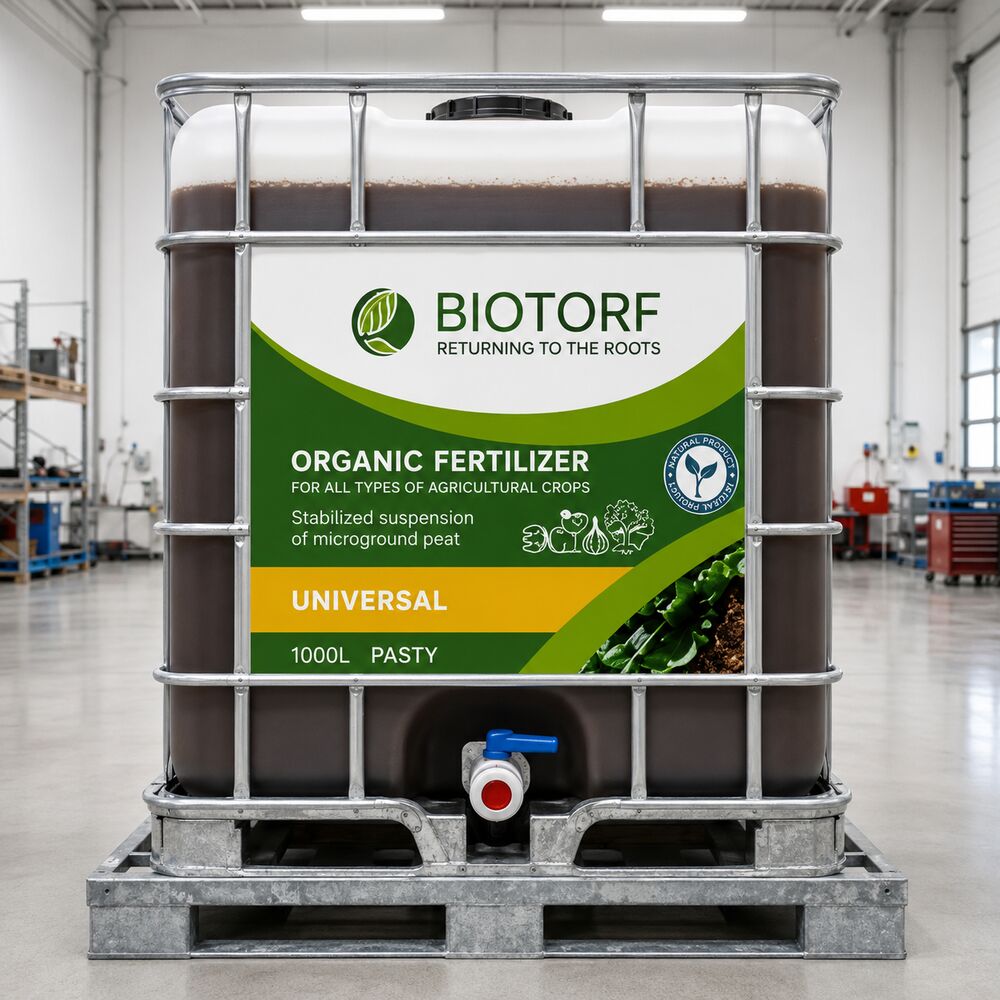
| Product | BIOTORF, stabilised suspension of micronised peat in paste form |
| Humic acids | 45–52% |
| Fulvic acids | 18–22% |
| Particle size | Below 100 microns |
| Shelf life | At least 36 months. A small precipitate is mixed back in |
| Capacity | Up to 1,500 tonnes of paste per month |
| Dilution | 1 litre of paste mixed with 4 litres of water makes a working concentrate |
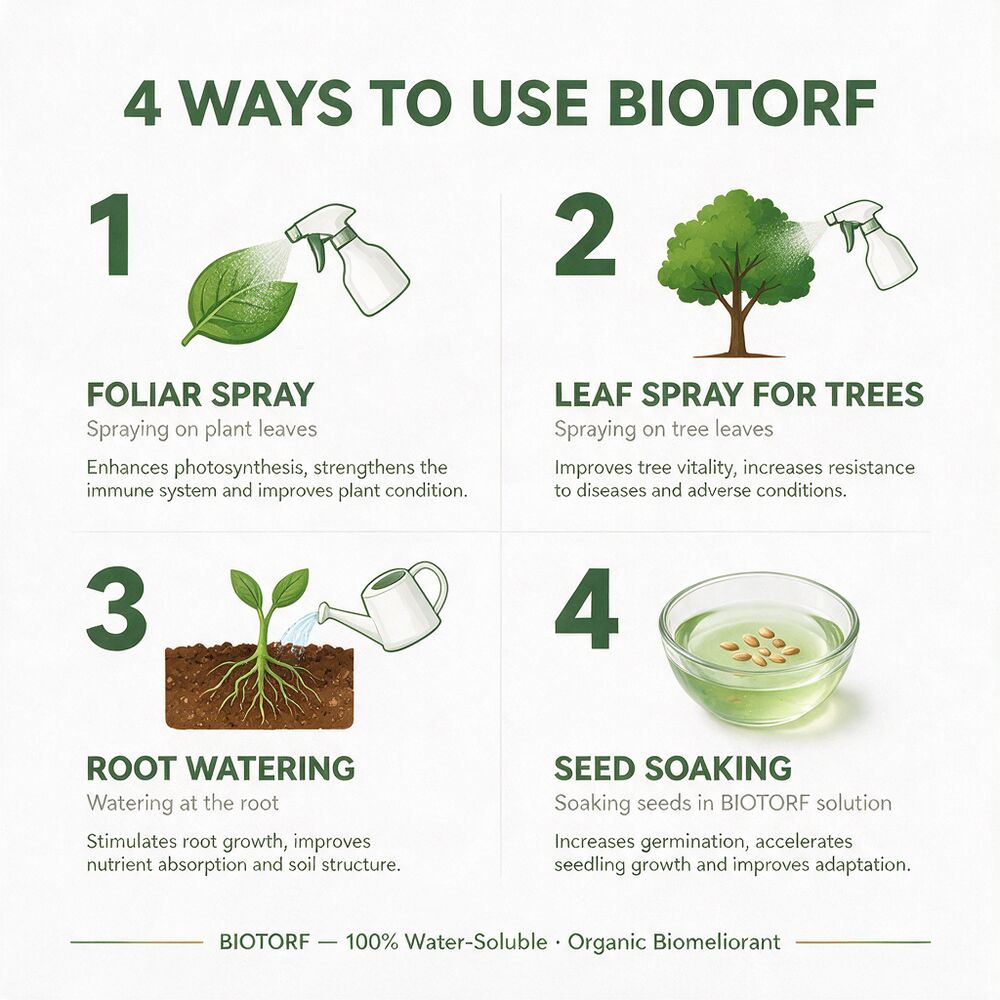
| Use | 10% solution for root feeding and seed soaking (100 ml concentrate per 1 l of water). 1% solution for foliar feeding (10 ml per 1 l) |
| Frequency | Foliar feeding 1–3 times a week, root feeding every 10 days, seed soaking once |
| Compatibility | Can be used with other fertilizers and chemical plant protection products |
| Packaging | From 100 ml to 1,000 l: canisters, barrels and 1-tonne IBC containers (Eurocube). One tonne of paste gives about five tonnes of concentrate |
| Minimum order | Free 2-litre sample for trials. Commercial minimum on request |
| Documents | Russian technical specification TU 039010-01-90160664-2025, English safety data sheet and 2025 laboratory reports (pathogens, pesticides, humic substances), on request |
Field results reported by the producer
The producer reports field trials in 2024 on cotton in Uzbekistan and on bananas, coffee, maize and papaya in Uganda and Equatorial Guinea. Two examples from the producer's 2026 presentation:
| Trial | Producer-reported result |
|---|---|
| Banana seedlings, Mbarara, Uganda, 24 November – 31 December 2024 | On day 8, treated plants measured 35–47 cm against 14–16 cm in the untreated control |
| Cotton, Tashkent region, Fergana Valley and Samarkand region, Uzbekistan, 20 June – 19 August 2024 | Treated plots: plants up to 90 cm, more than 12 branches, 23–47 bolls. Control plots: up to 70 cm, about 9 branches, 15–21 bolls |
The producer states that BIOTORF is exported to nine countries, including Kenya, Tanzania, Uganda, Egypt, Equatorial Guinea and Venezuela, and that it received a bronze medal at the Golden Autumn 2023 agricultural exhibition. These claims have not been independently verified for Philippine conditions, so a local trial on the buyer's crops is recommended before commercial volumes.
Who it is for
Fertilizer importers, agricultural distributors and commercial farms.
What the importer needs
- The regulator depends on the product: the Bureau of Agriculture and Fisheries Standards (BAFS) for organic soil amendments, the Fertilizer and Pesticide Authority (FPA) for other fertilizers.
- Registration, sample import and testing requirements are clarified with the Philippine importer and the competent authority.
- Import duties depend on the tariff code and are checked in the Philippine Tariff Finder.
For a pelletized organic fertilizer from poultry manure see Gigantin Bio organic fertilizer.
How a request works
- 1. Send an inquiryTell us what product, volume and supply format you are looking for.
- 2. Supplier matchingWe identify a suitable manufacturer from Primorsky Krai and request current information.
- 3. Document checkWe clarify specifications, export documents, packaging, pricing basis and market requirements.
- 4. Direct negotiationThe buyer and supplier discuss commercial terms, samples, logistics and a possible trial shipment.
Frequently asked questions
How is the humic paste used?
One litre of paste is mixed with four litres of water to make a working concentrate for seed soaking, foliar spraying and root feeding.
What is the humic and fulvic acid content?
Humic acids 45–52% and fulvic acids 18–22%, according to the producer. Particle size is below 100 microns.
Can I get a sample for a trial?
Yes. A free 2-litre sample is available for trials.
What is the shelf life?
At least 36 months. If a small precipitate forms, it is mixed back in.
How is it packed?
In 1-tonne IBC containers. One tonne of paste gives about five tonnes of concentrate.
Which authority regulates it in the Philippines?
It depends on the product: BAFS for organic soil amendments, FPA for other fertilizers.
Official sources
This is a general orientation, not legal advice. Requirements change, so the importer should confirm them with the relevant authority or a licensed customs broker before shipment.
- Bureau of Agriculture and Fisheries Standards (BAFS), divisions and registration functions
- Fertilizer and Pesticide Authority (FPA), frequently asked questions
- Tariff Commission, Philippine Tariff Finder